
Case Study 3: Institutionalizing a 4-Million-Unit Blockbuster into a Standardized NPI System
From Ad-hoc Delivery to a Scalable Supply Chain Operating System
The Impact
- Scale: Successfully delivered 4,000,000 units globally (CP09/S718 Senior Phone)
- Financial Impact: Generated over $28M (200M RMB) in net profit
- Legacy: Transformed fragmented execution into a standardized NPI operating system
4M Units Delivered | $28M Profit | NPI System Established
Executive Summary
The Problem
A 4M-unit success depended on unstable manual coordination, reactive firefighting, and project knowledge that was not yet captured as a repeatable system.
My Action
I redesigned the NPI workflow into a structured, cross-functional operating system with stage-gates, ownership clarity, and integrated risk-control loops.
The Result
A repeatable NPI system enabled future high-volume projects to scale with less ambiguity, less firefighting, and better control.
Ad-hoc Execution → Post-Mortem Review → System Design → Stage-Gate Standardization → Scalable Growth
1. The Hidden Risk Behind Success

The CP09/S718 Senior Phone became a major commercial success, reaching 4 million units with strong quality stability.
- High-volume production with consistent quality
- Delivered across multiple markets and customizations
- Generated over 200M RMB in net profit
However, the success relied heavily on manual coordination and reactive problem-solving.
The real risk was clear: this success could not be reliably replicated at scale unless the execution logic was captured, standardized, and controlled.
2. My Strategic Intervention
NPI Supply Chain Operating System (Designed & Implemented by Angela Yang)
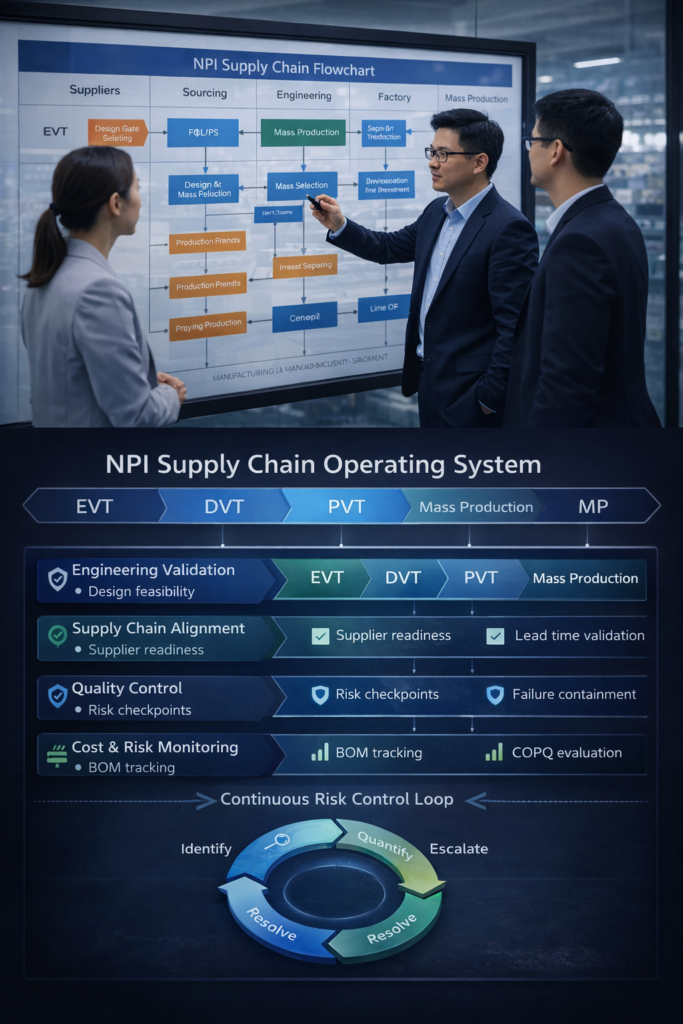
This system became the standard operating model for future NPI programs.
Step 1: Process Mapping
- Conducted a full post-mortem of the 4M-unit project
- Identified bottlenecks across sourcing, engineering, quality, and production
- Separated one-time personal coordination from repeatable process requirements
Step 2: System Design
- Built a complete NPI Supply Chain Flowchart
- Defined structured stage-gates from EVT to Mass Production
- Converted implicit project knowledge into explicit checkpoints and decision logic
Step 3: Cross-Functional Standardization
- Aligned R&D, Procurement, Quality, and Production under unified checkpoints
- Removed ambiguity in ownership and decision flow
- Made stage-gate decisions depend on evidence rather than confidence or informal follow-up
Step 4: Risk Control Integration
- Introduced structured risk assessment loops
- Prevented uncontrolled engineering changes and customizations
- Created a repeatable control model for future high-volume NPI programs
3. Business Impact
Scalable NPI System
Reduced Firefighting
Repeatable High-Volume Delivery
This initiative transformed a one-time success into a permanent organizational capability, ensuring future large-scale programs could run in a controlled and scalable way.
More importantly, it made NPI risk visible earlier: unclear ownership, missing stage-gate evidence, uncontrolled engineering changes, customization risk, and fragile handoffs could be detected before they became production chaos.