
Case Study 1: Resolving Critical PCBA Coating Failures for a Fortune 500 Appliance Brand
From Compliance Breakdown to 100% Process Stability
The Impact
- Client Category: Global Fortune 500 Home Appliance Brand (Whirlpool)
- Project Issue: PCBA conformal coating failures during NPI, including thickness non-compliance, bubble defects, and uneven appearance
- Outcome: Achieved full compliance with the 2mils–4mils requirement, eliminated bubble defects, and stabilized the process before schedule slippage occurred
100% Compliance | Zero Bubble Defects | No Production Delay
Executive Summary
The Problem
A critical appliance project stalled because the automated coating process could not meet strict thickness and appearance requirements.
My Action
I rebuilt the process through structured DOE, evidence-based parameter validation, and factory-floor execution when direct intervention became necessary.
The Result
The process reached stable compliance, defects were eliminated, and production timing was protected.
Process Failure → DOE Experiment → Parameter Optimization → Stable Production
1. The Crisis
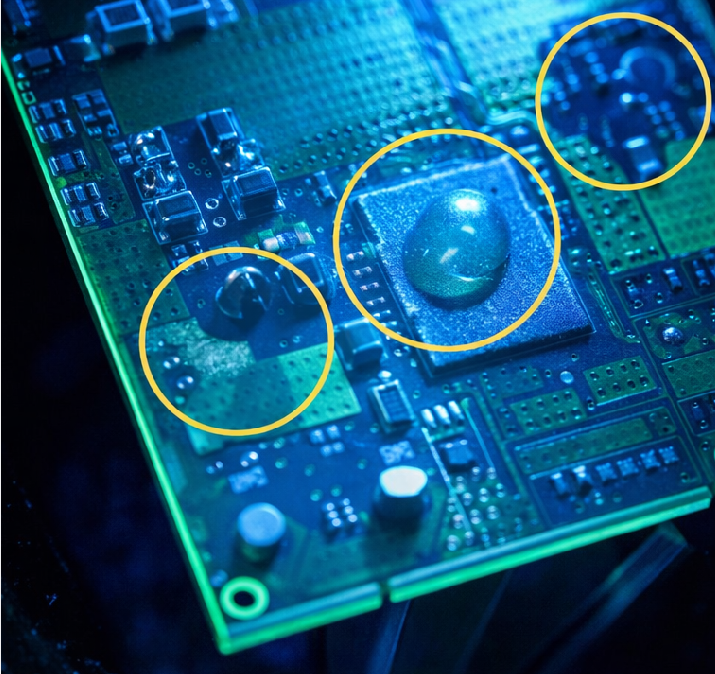
During the NPI phase of a critical Ice Maker project, the automated PCBA conformal coating process failed and created three immediate risks:
- Coating thickness could not consistently meet the strict 2mils–4mils requirement
- Severe bubble defects compromised moisture resistance
- The coating appearance was highly uneven, creating quality instability
At this point, the issue was no longer a normal process deviation. It was a production-readiness problem that threatened the project timeline.
2. My Intervention

Instead of accepting temporary fixes, I rebuilt the process through a structured Design of Experiments (DOE):
Step 1: Thickness Control
- Developed a new spray program to optimize speed and routing
- Tested material-to-thinner ratios and locked in the optimal 1.5:1 ratio
- Compared multiple nozzle sizes and selected the 19# sprayer as the best solution
Step 2: Bubble Elimination
- Introduced a mandatory 15-minute degassing period after mixing
- Re-engineered curing through a 9.6-meter graduated temperature tunnel before final oven curing
Step 3: Appearance Standardization
- Created a new automated application program to ensure consistent coating appearance across the board
Experimental Validation
The DOE confirmed that Mode 1 delivered the strongest balance of thickness compliance, appearance quality, and process stability, using the 1.5:1 ratio with the 19# nozzle. The original report also documented that the appearance was even and bubble-free under this configuration.
| Mode | Ratio | Nozzle | Assessment |
|---|---|---|---|
| Mode 1 | 1.5:1 | 19# | Best overall result |
| Mode 2 | 1.5:1 | 20# | Less stable thickness |
| Mode 3 | 1.5:1 | 21# | Below target in multiple points |
| Mode 4–6 | 2:1 | 19#/20#/21# | Inferior to Mode 1 overall |
This validation turned the issue from a subjective factory debate into a controlled process decision supported by test results, parameter comparison, and repeatable evidence.
3. Business Impact
100% Compliance
Zero Bubble Defects
Timeline Protected
The intervention stabilized the process before it could escalate into a delivery risk. More importantly, it converted an unstable process failure into a validated, repeatable production method.
What This Case Proves
When factories fail at process control, the real issue is not effort — it is the absence of a system.
I bring structure, validation, and discipline to manufacturing environments where quality cannot be left to chance.
This intervention transformed a reactive defect-fixing process into a controlled, repeatable manufacturing system.
What This Means for Remote Risk Review
Before a project reaches this level of escalation, many warning signs can often be detected remotely: missing evidence, unclear process parameters, weak corrective actions, delayed decisions, or supplier claims that do not match available quality data.
A remote review cannot replace every factory-floor intervention. But it can identify whether the supplier’s explanation is technically credible, what evidence is missing, and whether the project requires clarification, escalation, or direct process intervention.